ChEn 273 Homework Hints
2.6 - Please use $1.39/gal instead of the $1.25/gal.
2.11 - The mass is equal to the density times the volume. The volume is equal to the height times the cross sectional area. If you set up an equation where the mass of the entire object is equal to the mass of the displaced fluid, the cross-section area cancels out because it appears on both sides of the equation.
2-31 - Note that the problems in the workbook are different than the problems in the textbook. I think the problems in the workbook make it look confusing. Please work the problems in the book.
3-48 – (a) Use 65 deg F; (b) use -30 deg C; (c) start with a delta T of 40 K; (d) start with a delta T of 40 deg R.
4.1 to 4.3. There may be several ways to do these problems, but I am trying to get you to practice using the balance equations. Please start with the general balance equation, cross out terms, and then solve.
4-17.
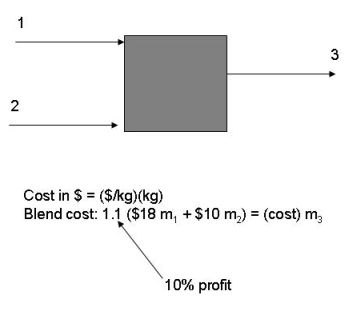
4.20. You may consider the water absorption rate as an outlet stream in the process flow diagram.
4-28. The only thing required on this problem is to set up the degree of freedom analysis. No calculations are required!
4-29. Only solve for the requested values. The answer for the toluene recovered should be 89%.
4-34. Make the solid filter cake one stream (m6) and the solution that accompanies this cake a separate stream (m5). The relationship is m6/m5=10. Also, be careful; 45% of the water entering the evaporator (after the mixer) is evaporated). Skip part (e).
4-43. Please do the DOF analysis for both part (a) and (b).
4-45. No DOF analysis required. This problem looks hard because of all the reading, but it is really pretty easy.
5-12. You have to calculate the mass of the empty tank as well as the number of moles that fit into the tank, then determine a molecular weight of the new gas.
5-23. (b) Buoyant force (upwards) = Weight of balloon (downward) + Force
of cable (downward)
(c) Net force after cable release = buoyant force - weight = mass*acceleration
5-34. The answers in the back of the book are slightly wrong, since the answer key used 640 mtorr instead of 604 mtorr. It is convenient to use the extent of reaction to solve part (a). On part (c), multiply the rate by the time, then multiply by the MW of SiO2 and divide by the density of SiO2. This gives a unit of m/s.
5-63. Please do this once in Excel and once in Mathcad (i.e., parts a-c, but not d).
6-25. You can assume 1 atm total pressure for both scenarios.
6-33. The note about the mirror is meant to make you think about what vapor
pressure means. This is the pressure at which water condenses at 40 C. You
can compare this with the vapor pressure of water at this same temperature.
The ratio should give the mole fraction of water vapor at 40 C or at any temperature
above 40 C... Why?
On the last part, you will have to do balances on water and on dry air to
get 2 equations and 2 unknowns.
6-61. This problem is intended to make you think about whether the gas mole fraction is known or the liquid mole fraction is known, and how this relates to dew point and bubble point calculations. Please make this connection in your mind.
6-68. You can download the excel file with the data here.
6-95. Once you find the compositions, you will have to do the species balances and total balance.
7-22. There is a typo in the problem statement. The first enthalpy should have units of kJ/kg, not J/kg.
7-28. Assume that the total pressure is 1 bar.
7-33. Be sure to compare the temperature from part (a) to the turbine exit temperature to see what phase exits in the exit stream. On part (b), it is asking for the total energy transferred to the turbine, which is Q-Ws. It does not ask to distinguish between Q and Ws. Older editions of the book said to assume Q=0 on this problem. Either way is fine.
7-41. You may assume that the total pressure is 1 bar or 1 atm (the workbook assumes 1 atm).
7-42. You will have to do a total mole balance and a balance on one of the species in order to find the molar flow rates of the two exit streams.
7-51. If the temperature is known, this is not an interative problem.
7-56. This problem may be easier if you solve the mechanical energy equation for outlet velocity rather than mass flow rate.
8-74. The hardest part of this problem is the recycle. However, from an overall balance, you can see how much the inlet flow is reduced (by some factor), and hence you can adjust the heat flow, etc., by this same factor. You should be able to prove this by balances, but this is not required on this homework problem.
9-7c. Just write down the reaction and find the heat of reaction like on the other parts of the problem.
9-7d. The (c) phase means crystalline, which should be interpreted as solid. Therefore you need the heat of melting as well to get the solid to a liquid.
9-26. The feed to the reactor, after the blending of the recycle stream, is 2 mol C2H4 and 1 mol of O2. The fresh feed is unknown. Use element balances on the reactor, and then overall element balances. I think this will be easier in terms of the moles of each species in each stream rather than the mole fractions. A DOF analysis is not required. If you calculate the moles of each species in each stream, you do not have to calculate mole fractions (ignore this part of the problem statement). The scaling factor for part (c) is the ratio of the molar flow rate of C2H4O to the moles C2H4O produced when the basis in part (a) was used.
9-32. This problem will go easier if you use an extent of reaction variable, so that the energy balance has only one unknown. The solver can be used to find the extent of reaction that makes the energy equation balance.
9-49. The only way to solve this problem is to assume that the H in the coal starts as H2(g). Please comment on how good of an assumption this really is. Answers: Part c: phi = 1.01 x 10^-6 kg SO2/kJ of heating value.
9-56. Assume a basis of 100 moles of exit gas. Answers: Part a: Fuel is 69.9% CH4, % Excess air is 50%. Partb is in back of book.
9-65. I only want you to calculate the adiabatic flame temperature for this system as part (a). You do not have to derive a polynomial expression. For part (b), explain why this temperature is not accurate. In part (c), do the same calculation for air instead of pure O2 (i.e., 30% excess air). Skip part (d).
11-6. The author has gone out of his way to be subtle on this problem statement. Perhaps he should have said that the flow rate was adjusted to see when the steady-state level in the tank was full, and that this value was 60 L/min. Also, when things are proportional, we say that it is a constant (say "k") times the value, so k*V in this case.
14-6. Wow- This was a hard problem. The author's answer key had lots of mistakes.
The solubilities are not in the book, but are listed in Perry's Chemical Engineering
Handbook. To be consistent, let's use the following solubilities:
0.002 kg CaCO3/100 kg liquid H2O
0.003 kg CaSO3/100 kg liquid H2O
I found that sometimes drawing a unit separately, with the inlet and outlet
streams, along with the different phases, helped me to sort through this problem.
See the TA's to check answers.
On 14.6e, the second part of this problem is somewhat ambiguous. What
is really wanted is the mass fraction of each component in the wet solids.
14-7. I found it a lot easier to do this problem if I calculated the heat of formation of coal. The high heating value of the coal is given, which is the negative of the heat of combustion assuming that the hydrogen goes to liquid water. All reactants and products are 25 C for this value of the heat of combustion. Since the heat of combustion is the total enthalpy of the products minus the total enthalpy of the reactants, and the total enthalpies at 25 C are merely the weighted sums of the heats of formation, the only unknown in this equation is the heat of formation of coal. Assume a basis of 100 kg of dry coal, calculate the products, and then calculate the weighted sum of enthalpies, and finally determine the heat of formation of the coal.
14-10. The only way that this problem makes sense is if the heat input to the boiler is really the heating value of the coal going into the boiler. This is the way that the regulations are written.
14-14c. From the flow rate of methane, multiply the flow rate by the heat of combustion (i.e., the high heating value). This is an approximate heat addition rate. Then divide by the high heating value of the coal.