Topography shapes the wavefield.
We study how ridge shape, asymmetry, and unresolved roughness change the internal waves generated by oscillating flow over bathymetry-like features.

Internal waves in stratified oceans, atmospheres, and laboratory tanks
We study how tidal flow over seafloor topography generates internal waves, and how those hidden waves move energy through stratified oceans, atmospheres, and laboratory tanks. In the lab, we make the waves visible, isolate the physics, and connect measured motion to models that can scale outward.
Our central question
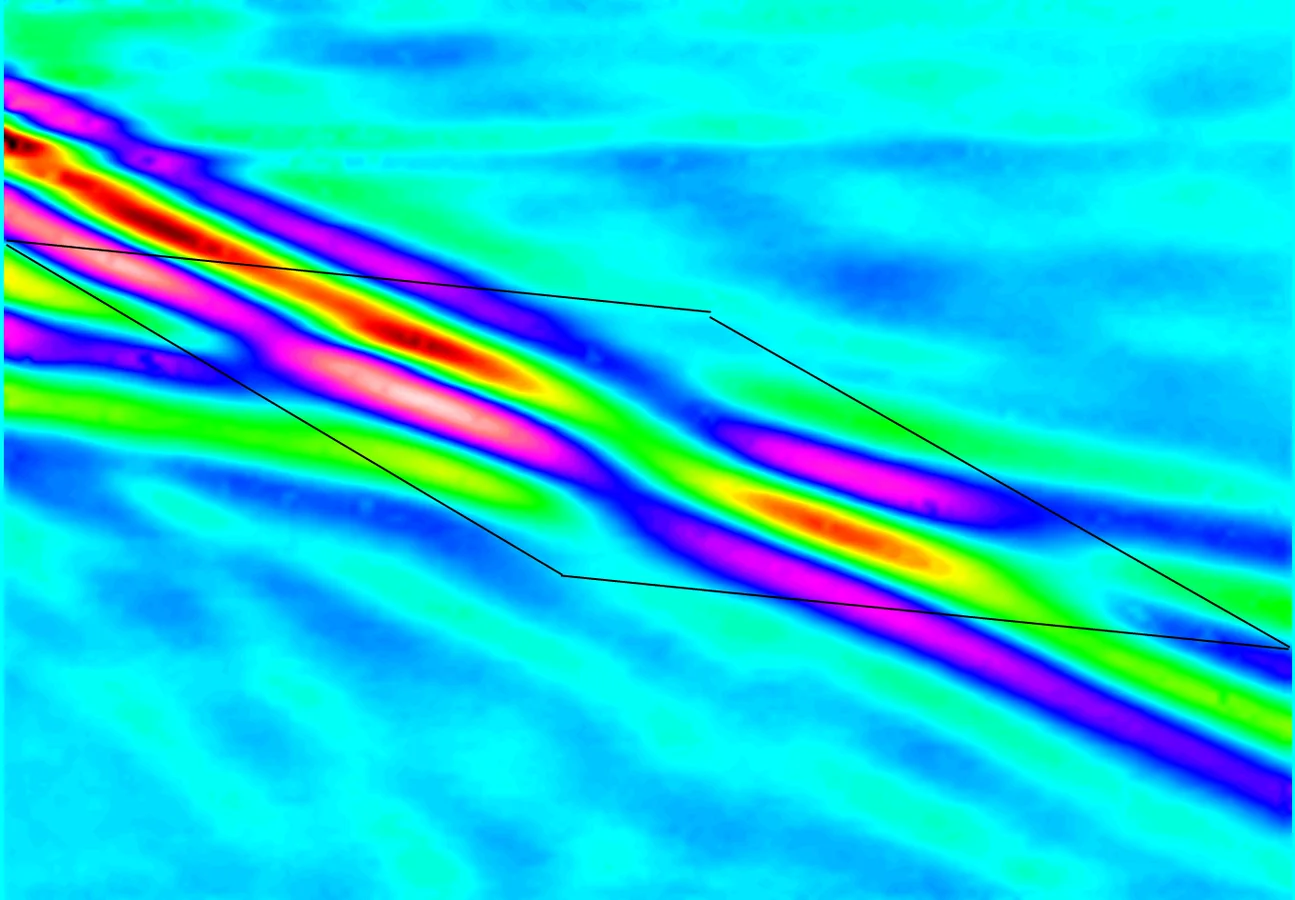
Internal waves are generated any time the stable stratification of the ocean is disturbed. One of the greatest generators is tides consistently forcing ocean water back and forth over seafloor topography. We focus on the waves generated in this manner as well as mechanisms that result in a redistribution of energy across scales, causing wave propagation across ocean basins or local breaking and mixing.
We study how ridge shape, asymmetry, and unresolved roughness change the internal waves generated by oscillating flow over bathymetry-like features.
We investigate evanescent regions, turning depths, and variable buoyancy frequency profiles to understand when decaying waves become propagating internal waves.
We examine colliding beams, harmonic generation, and high-frequency wave interactions to learn how energy moves across scales.
Ocean motivation
Internal waves move inside the water column along density gradients. We focus on how tidal currents over ridges, seamounts, and rough bathymetry convert energy into waves that can travel, interact, and mix the ocean.


Research areas
Our work blends physical intuition with careful measurement. We use controlled experiments to reveal wave behavior that is difficult to isolate in the ocean or atmosphere, then compare those observations with analytical and numerical models.
We examine how buoyancy frequency profiles and turning depths determine whether energy decays locally or enters a propagating wavefield.
We test how the shape of a ridge or rough plateau changes wave amplitude, wavelength content, and kinetic energy distribution.
We follow wave energy across interactions, harmonics, and model scales so simplified descriptions stay connected to real dynamics.
Students and collaborators
Students in our group learn to make hard-to-see physics visible: building experiments, processing images, comparing models, and asking where the energy goes next. We welcome prepared students and partners who want to work on stratified-flow questions with real consequences for ocean and atmospheric dynamics.