Research story

Internal waves are hidden conveyors of energy.

Our recent work focuses on tidal flow over topography: how ridges, roughness, asymmetry, and realistic bathymetry convert tidal motion into internal waves that matter for ocean energetics and mixing.

Ocean-to-lab connection

We simplify ocean topography without losing the energy question.

Bathymetry maps make the problem concrete: ridges, fracture zones, seamounts, and continental slopes give tidal flow three-dimensional geometry to push against. We simplify that seafloor relief into controlled ridges, roughness, and repeated topographic features so we can isolate which shape details change internal-wave generation before asking how they scale outward.

Measurements are made in controlled stratified tanks, where imaging and analysis turn subtle density-gradient motion into a quantitative wavefield.

Bathymetric map of the Atlantic Ocean showing mid-ocean ridge structure and seafloor relief
Atlantic bathymetry shows the ridges, slopes, and rough relief that tidal flow can push against. Image from NOAA via Wikimedia Commons, public domain.
Schematic of internal wave experiment with camera, tank, oscillating topography, mask, and light box
Experimental layout for topography-driven internal-wave measurements. Related article: Lee et al., 2025.

Measurement, modeling, synthesis

A clearer energy budget is the point.

We use synthetic schlieren and related laboratory methods to measure density perturbations, then compare the data with analytical and numerical models. The goal is not a prettier picture; it is a clearer account of where internal-wave energy goes.

From forcing to far field

A compact map of our internal-wave questions.

Global map of modeled internal tide energy patterns
Global internal-tide velocity displacement representative of internal waves Simmons et al., 2004.

Why this matters

Some tidal energy becomes internal-wave energy.

Internal tides are generated when barotropic tidal currents interact with variable bottom topography. That energy can travel far from the source region and eventually contribute to mixing in the stratified ocean.

01

Generation over topography

Tidal flow over seafloor-like features can convert barotropic motion into internal waves. We ask how realistic shape details such as asymmetry and roughness change the kinetic energy and wavelength structure of the generated wavefield.

Schematic of tidal flow over a ridge generating internal wave beams
Schematic of internal wave generation by tides over topography. Source: 2023 NSF proposal figure.
Comparison of measured and simulated internal wave fields over rough topography
Internal-wave response over rough oscillating topography. Related article: Wilson and Crockett, 2024.
02

Roughness and asymmetry matter

Real seafloor topography is not a clean triangle or a smooth ridge. We use controlled rough and asymmetric shapes to learn which geometric details change the radiated wavefield and which can be simplified safely.

03

Variable stratification and turning depths

In regions where local stratification is weak, internal-wave responses can be evanescent. We study when those responses cross a turning depth and become propagating internal waves that can carry energy away from the source.

Diagram and visualization showing a turning depth in a stratified fluid
Variable stratification and turning-depth geometry in internal-wave experiments. Related article: Lee and Crockett, 2019.
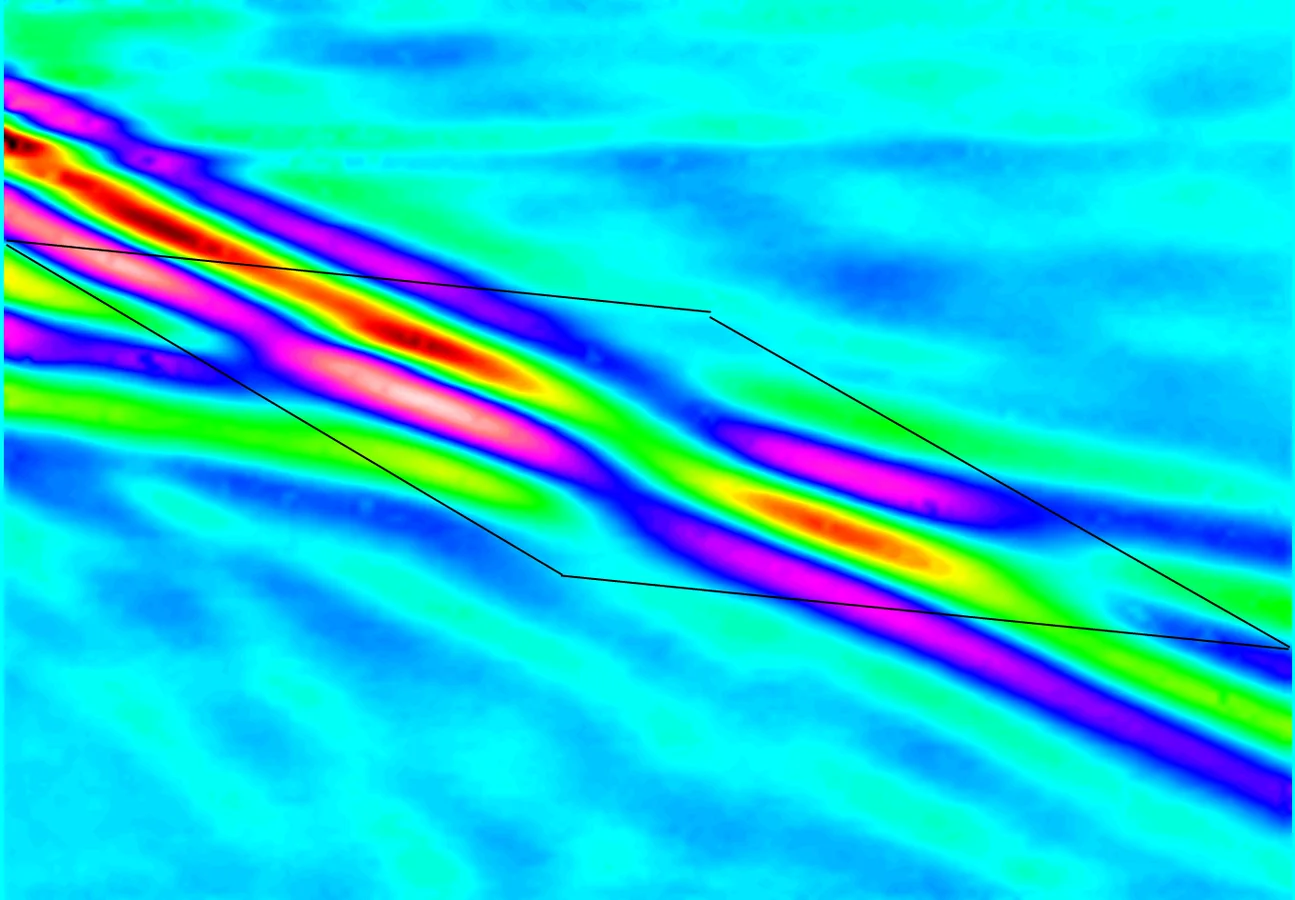
Color contour field showing crossing internal wave beams
Internal-wave beam structure in a stratified tank. Related article: Smith and Crockett, 2014.
04

Wave interactions and harmonics

Internal waves do not simply pass through one another. We investigate collisions and interactions that generate harmonics, exchange energy among scales, and complicate simplified models of ocean and atmospheric wave fields.