Stratification
The density profile sets the buoyancy frequency. When stratification changes with height, waves can bend, slow, reflect, decay, or pass through a turning depth into a new region.
Internal wave dynamics
An internal wave is a wave that travels within a stably stratified fluid rather than on its outer surface. In the ocean, these waves move through varying density gradients created by temperature and salinity, carrying energy and momentum through water that can look still from above.
The basic idea
When a fluid is layered by density, a displaced parcel tends to move back toward the level where its density fits. That restoring motion can oscillate. When the oscillation organizes in space, the result is an internal wave.
Surface waves use the air-water interface as their visible boundary. Internal waves use density gradients inside the fluid. The interface may be sharp, like a two-layer tank, or smoothly distributed, like much of the ocean below the near-surface mixed layer.
The important quantity is the buoyancy frequency, often written N. It describes how quickly a displaced fluid parcel would oscillate vertically in a stable density gradient. Internal waves generally exist at frequencies below N, and their direction, speed, and energy pathways depend on the stratification around them.


What controls the motion

The density profile sets the buoyancy frequency. When stratification changes with height, waves can bend, slow, reflect, decay, or pass through a turning depth into a new region.
The forcing frequency determines whether a wave can propagate in a given layer. If the local conditions do not support propagation, the response may become evanescent.
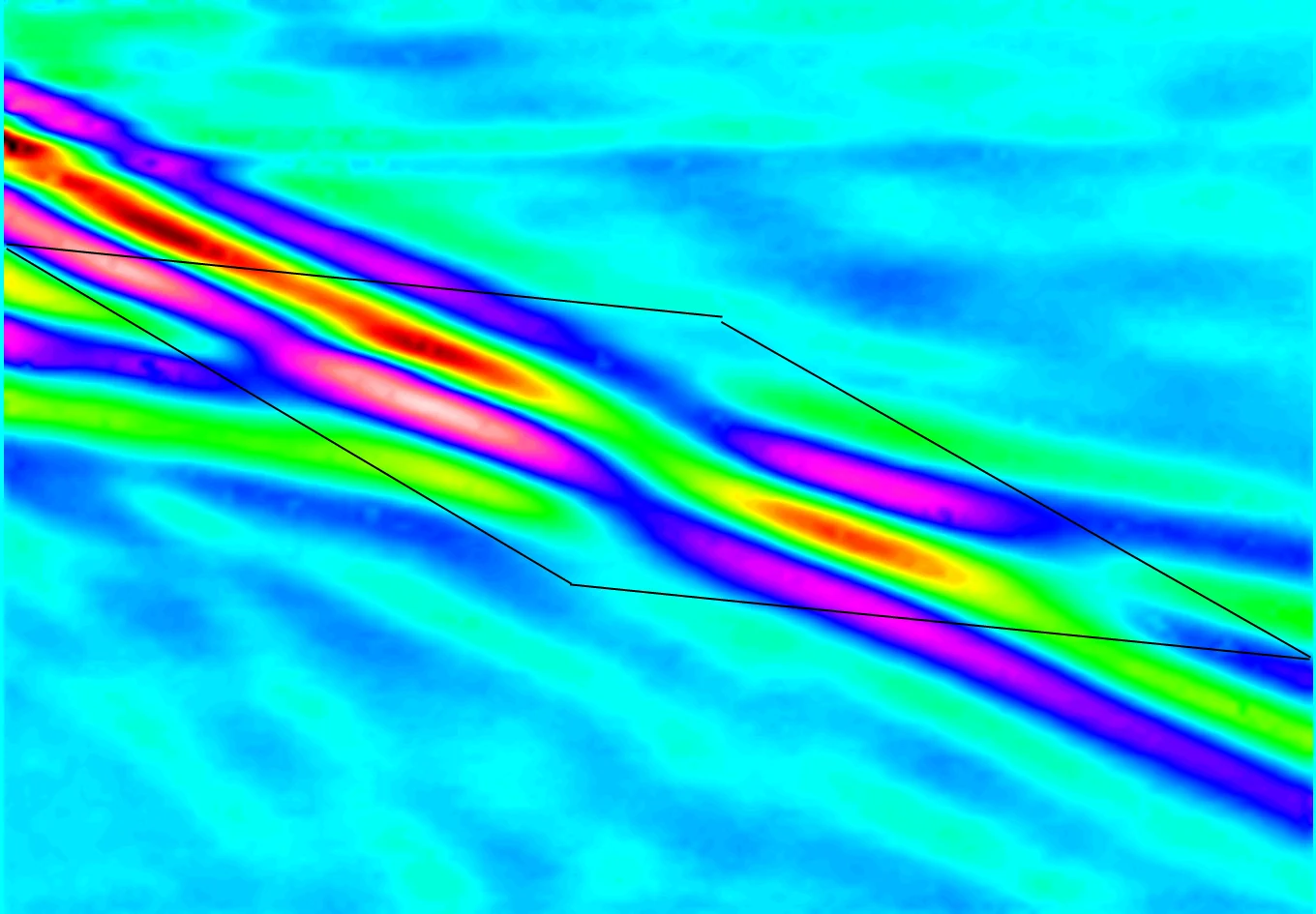
Internal wave energy often travels in beams at angles tied to wave frequency and stratification. That geometry makes laboratory visualization especially powerful.
Ridges, slopes, and rough seafloor-like features can convert oscillating flow into internal waves as fluid is pushed up and around them. Small shape details can change how much energy leaves the source.
Wave beams can collide, generate harmonics, and move energy across scales. Those interactions help explain why simple wave fields become complex.
Internal waves can contribute to ocean mixing and transport. Understanding when they propagate, break, or transfer energy matters for larger-scale fluid systems.
A mental picture
Push one region up or down, and buoyancy tries to restore it. The disturbance can travel away from the source as a wave, but the path is constrained by the density structure and by the frequency of the forcing.

Why topography matters
As barotropic tidal flow moves over ridges and rough bathymetry, it can lift and lower density layers. That motion converts some tidal energy into internal waves, which can propagate away, interact with other waves or boundaries, and contribute to mixing.
From concept to lab question
Oscillating flow over topography, moving boundaries, or wave-wave interactions create disturbances in a stratified fluid.
The local buoyancy frequency, forcing frequency, and geometry determine whether the wave carries energy away or remains trapped near the source.
We use controlled experiments and models to connect visible wave patterns to energy pathways, harmonics, and mixing-relevant behavior.